Top 10 Best Baseball Stadiums in Chicago

#10. Columbus Baseball Park

Baseball is the supreme home-sport in America, dating back as far as the 19th century. Ballparks have become major tourist destinations, and regular go to’s for baseball fanatics because of their deep-rooted connection to American Culture.

Each ballpark exhibits its own unique trademark, and selecting the best can be quite subjective as preferences can be as diverse as when you are a spectator, or you are someone playing on the field.

Stadiums in Chicago are no different, with each offering a unique experience for sports fans. In this article, we give you a list of the best baseball stadiums in Chicago based on player advantage, spectator experience, and historical significance. If you haven’t already visited these Chicago baseball fields, be sure to add them to your list.

#10. Columbus Baseball Park

The first Chicago baseball stadium we want to highlight is Columbus Baseball Park located on the West Side of the city in the Austin neighborhood. Proclaimed as a National Historical Landmark in 2003, the 135-acre park was initially conceptualized by then world-renowned landscape architect Jen Jensen between the years 1915 to 1920. Columbus Park was even named as one of the Illinois 200 Great Places in 2018.

This particular baseball diamond is overlaid with artificial turf and the outfield fence extends up to 300 feet. The turf makes it a popular destination year-round, providing the perfect opportunity for residents to enjoy their time at the park year-round.

#9. Stadium at Devon and Kedzie

Built in 1938, the former two-field Thillens Stadiums was once a notable landmark because of the huge, rotating, baseball on a pole that attracted baseball fans from the city and beyond. It has been a witness to numerous traditions that have shaped the once quaint town through its size, comparable to a major league baseball stadium.

Today, this baseball field in Chicago hosts youth baseball and softball leagues, giving the younger generation an opportunity to play on a field with a rich tradition. You can also organize events that could seat up to 2,400 people and take part in the community’s nostalgic appreciation of the once glorious Stadium at Devon and Kedzie.

#8. Les Miller Field

#8. Les Miller Field

Eighth on our list is quite a young stadium (less than 30 years since its first game) but already has major historic occasions on record. Les Miller Field, inside Curtis Granderson Stadium, has hosted the Horizon League Baseball Tournament five (5) times between 1998 to 2012. The field is made of synthetic turf complete with an electronic scoreboard and a padded outfield wall.

The distances of the outfield fences from the home plate are 320 feet (left fence), 370 feet (left-center fence), 396 feet (center fence), 370 feet (right-center fence) and 324 feet (right fence). The stadium could fit about 1,784 spectators with a luxury suite that can accommodate 40 people. Les Miller Field is considered one of the high-flying college baseball fields In Illinois and we heard that they’re still upgrading to more facilities!

#7. Clark (Richard) Kerry Wood Cubs Field

Located within the 22.42-acre Richard Clark Park along the east bank of the Chicago River, the Clark Kerry Wood Cubs Field is commonly used for inter-high school baseball tournaments in Chicago. The field is named after all-star Cubs pitcher Kerry Wood and it can accommodate up to 1,250 spectators with various recreational options around the park including bike trails, soccer fields, and a boathouse.

Nearby public high schools use this baseball stadium in Chicago both during and after-school hours. Recreational leagues and the general public also get use out of this robust and impressive facility.

#6. Ping Tom Baseball Field

If you’re looking for a picturesque Chicago baseball stadium with unmatched city views in the background, Ping Tom Baseball Field is it. Built around Chinese landscape design components, Ping Tom Park in Chinatown was once a railroad yard converted into a 17.44-acre green urban park.

Today, this hidden jewel is home to the Chicago Rattlers Baseball Program for little baseball protégés who have big dreams ahead of them. It has also become a favorite for residents in South Loop, east Pilsen and, Chinatown. It is located near the river where you can easily hop on a boat going to Guaranteed Rate Field.

#5. Garfield Park Baseball Fields

Garfield Park Baseball Fields

Yes, fields with an ‘s’. Multiple baseball diamonds exist within the 184-acre Garfield Park, home of the non-profit Garfield Park Little League. This urban park is one of Chicago’s most well-known multi-facility parks complete with a playground, lagoon, jogging and biking trails, fitness center, as well as one of the largest greenhouse conservatories in the United States. This is recreation at its best.

This wasn’t always one of the city’s best baseball parks, however. In 2018, the Cubs Charities Diamond Project invested in revamping the baseball fields, partnering with the Chicago Park District to complete the task.

#4. Little Cubs Field

Built in 2008, the establishment of the Little Cubs Field spawned from a heart-warming story of fulfilling dreams. It was constructed as a replica of Wrigley Field complete with ivy-on-brick walls and extends to a center outfield wall that is 122 feet from the home plate.

The park is open to the public at free admission everyday (except when the stadium is fully reserved), offers free use of equipment (bats and balls), and includes picnic pavilions for the family. You can even grill on designated areas provided that you bring your own grilling materials! Little Cubs Field is one of the most unique little league baseball fields in the world.

#3. Impact Field

Impact Field is the newest, yet one of the most interesting, baseball fields on our list. The 6,300 seater stadium opened to the public in 2018 and serves as home to the Chicago Dogs. Impact Field is what you would expect of a modern baseball establishment complete with a 360-degree concourse where visitors can experience different vantage points around the stadium.

It houses six (6) spacious party decks that feature distinct vibes and souvenir shops with neatly-designed Chicago Dogs merchandise. The outfield walls are positioned at a distance of 312 feet, 350 feet, 390 feet, 370 feet, and 293 feet from left to right. This is surely a haven for both players and spectators.

#2. Wrigley Field

#2. Wrigley Field

Built in 1914, Wrigley Field has been a recipient of numerous distinctions. Apart from being the last Federal League Ballpark standing, it is known as the “windiest” stadium in MLB. It has hosted seven (7) World Series between 1918 to 2016 and seats around 41,100 people.

Wrigley Field is the biggest baseball stadium in Chicago and it features a manually-operated scoreboard even up to the present, amidst their installment of an HD video board. A special trademark of the park is its ivy-covered outfield walls that wilt and grow more or less simultaneously with the MLB Seasons. No wonder why Wrigley Field is a top tourist destination in Chicago.

#1. Guaranteed Rate Field

Guaranteed Rate Field

The most recommended baseball stadium on our record deserves the top spot because of its complete mix of history, ideal field specifications for pro-baseball, and absolute spectator experience. Guaranteed Rate Field is the home of three-time World Title holder, the Chicago White Sox.

It was established in 1991 after multiple relocations that started at an 1893 World’s Fair Cricket playing field. The distances of outfield walls from the home plate are 330 feet (left wall), 377 feet (left-center wall), 400 feet (center wall), 372 feet (right-center wall), and 335 feet (right wall). The 40,615-seater stadium is complete with a social area for drinks (Goose Island) and a kid’s zone featuring batting and pitching cages.

As one of the best baseball complexes in the United States, this destination is your ultimate baseball tour experience!

Get Out & Explore These Great Baseball Stadiums!

Feel like you want to be part of baseball history yet? Grab your friends and family and seamlessly experience any of these sites through Chicago Motor Coach Inc., a CONCACAF Gold Cup Transportation Service Provider. We also offer the best comfortable sporting event transportations and charter buses for your sports events. For further questions, please contact us at 847-260-9797 and let us know how we can help you.

Ultimate Guide to Selecting the right Charter Bus Rentals

Finding the right charter bus rentals for your group can be challenging. Did you put together the list of what everyone needs and wants? Does it fit your budget? How does everything work together logistically?

To help you, we created the ultimate guide to selecting the right charter bus rentals for your group. Discover the steps you must take to make sure your next charter bus rental goes smooth.

Ultimate Guide to Selecting the right Charter Bus Rentals

Group Info

The first step in selecting the right charter bus rentals is making sure you have all the group details.

Here are a few things charter bus companies ask groups.

  • How many people on the trip?
  • What is your itinerary?
  • Why do you need the bus? (Corporate Event, School Outing, etc.)
  • Do you need economy or premier accommodations?
  • Do you have children? Any special accommodations (e.x. wheelchair access)?

What is your Budget?

Once you have the details of your group, you need a final piece of information: the budget.

Several factors affect your transportation. For example, how big of a bus do you need? The larger the group, the larger your bus. Otherwise, you could have a group of cramped and impatient people.

And if you take a long-distance trip, you might want bathroom facilities on the bus. Then you can take fewer bathroom breaks and can get to your destination faster. A charter bus with a bathroom costs more.

Finally, if you want to impress a large group of corporate customers, you might want a premium charter bus.

5 Questions to Ask Your Charter Bus Rental Company

How much experience does your charter bus rental company have?

You can go with a new business; however, you benefit from working with an experienced charter bus company. Experienced drivers and corporations know how to handle a broad array of challenges.

Are you licensed?

Does the driver own a commercial license to drive a bus? What about the permits for the business? You might want to find out about commercial insurance if an accident occurs.

How old is your charter coach?

Charter buses last a lot longer today. Yet, older buses might not make use of updated technology. And older buses have more wear and tear that could cause mechanical problems.

If the vehicle looks safe, then the age is not the final determining factor. However, ask to ensure you get a quality vehicle for your trip.

What type of Charter bus do they recommend?

Asking the charter bus rental company for their recommendation does two things. One, you rely on the bus companies experience to provide you with the best service possible. Two, you gauge their understanding of your needs to make sure they are a good fit.

If they ultimately ignored your needs, look at alternative modes of transportation.

What standards do you require of your drivers

You want vetted drivers to ensure they hold a clean driving record and background. And you want them trained to operate a commercial bus, so they can keep you safe on the road.

We hire veteran drivers who provide you with the best customer satisfaction when using our corporate charter buses.

Final Thoughts

Plan your next charter bus trip, so your next event goes off without a hitch. Use the ultimate guide to find the right charter bus rentals for your next group outing.

For further questions, please contact us at 847-260-9797. Let us know how we can help you.

Visit Schaumburg

Did you know Schaumburg is the only suburb in the entire Chicagoland area that has a skyline? You can see the skyline while driving on I-53 near the building complexes surrounding Woodfield.

Beyond the mall, you also have millions of visitors coming to the convention center and IKEA every year. The suburban village is a destination in its own rights.

A Brief History of Schaumburg

A Brief History of Schaumburg

The first settlers to Schaumburg were the Sauk, Fox, Potawatomi, and Kickapoo tribes. By the middle of the 19th, the first German immigrants arrived from Schaumburg county in Germany.

The settlement German settlers dominated the area until well into the 20th century. If you want to see how they lived, make sure to visit the Spring Valley Nature Center & Heritage Farm. The working farm shows kids (and adults) what it was like to live in Schaumburg at the end of the 19th century.

Schaumburg remained a relatively isolated farming village until after World War II. The automobile changed everything. When the government constructed the Northwest Tollway in 1956, fueled its growth. That same year, Schaumburg formally incorporated as a village.

Suburban sprawl dominated the city’s expansion from the seventies until the turn of the century. Development only slowed when the city ran out of room to grow.

Popular Schaumburg Attractions

Schaumburg’s most popular attractions include Woodfield Mall, IKEA, and the Convention Center. Together, these attractions drive millions of visitors to Schaumburg every year.

At the center of it all is Woodfield Mall. The nation’s 11th largest mall keeps going strong almost 50 years after its construction. With over 300 stores and 5 anchor stores, the mall continues to generate huge interest as many malls around the US fail.

On the other hand, more visitors every year also chose to visit the IKEA store. One of two IKEAS in Illinois, the store’s assortment of furniture, lamps, and other home accessories is an experience all its own.

Additionally, the city is close to Chicago’s O’Hare International Airport. The proximity to the airport makes it a popular destination. People stay the night in a hotel and visit Woodfield or IKEA.

Take your next group trip to Schaumburg

While it’s not the most well-known place, you definitely need to check out Schaumburg on your next visit to Illinois. If you want to take your group on an outing to one of Schaumburg’s many attractions, then contact us today at 847-260-9797 for more information.

What Is a Charter Bus?

What is a charter bus, and how does it differ from other types of buses you see on the road? Whether you’re organizing a wedding, corporate event, or school trip, understanding your transportation options can make all the difference in creating a smooth, enjoyable experience for everyone involved.

A charter bus is essentially a private motorcoach that you rent exclusively for your group’s use. Unlike public transit buses that follow fixed routes and schedules, a charter bus goes where you want, when you want. You’re in control of the itinerary, and your group gets the entire vehicle to yourselves.

At Chicago Motor Coach, we’ve been helping groups navigate their transportation needs for over three decades. So let’s break down everything you need to know about charter buses, from the amenities you can expect to the costs involved and how to choose the perfect option for your group.

What Is Meant by Charter Bus?

What Is Meant by Charter Bus?

A charter bus is designed to transport groups of people together in one vehicle. The key distinction from regular buses — like those you’d find on city routes or school runs — is the private, customized service. When you book a charter bus, you’re not just renting a vehicle; you’re hiring a complete transportation solution that adapts to your schedule and destination.

These buses are built for comfort on longer trips, whether you’re heading across town or across state lines. They typically seat anywhere from 14 to 56 passengers, depending on the model, and come equipped with features that make group travel more enjoyable. The dedicated driver who comes with your charter bus rental stays with your group throughout the entire trip, handling navigation, parking logistics, and traffic concerns while you focus on the purpose of your journey.

Charter Bus AspectDetails
Seating Capacity14 to 56 passengers, depending on bus type.
Typical AmenitiesReclining seats, climate control, Wi-Fi, charging ports, entertainment systems, restrooms (on larger models).
Common UsesCorporate events, weddings, school trips, sports teams, religious groups, tours, airport transfers.
Pricing FactorsGroup size, distance, trip duration, bus type, season, additional amenities.
Safety FeaturesProfessional licensed drivers, regular vehicle inspections, federal safety standards compliance.
Key BenefitsCost efficiency, environmental friendliness, stress-free travel, team building, productivity on the road.

What Amenities Can You Expect on Charter Buses?

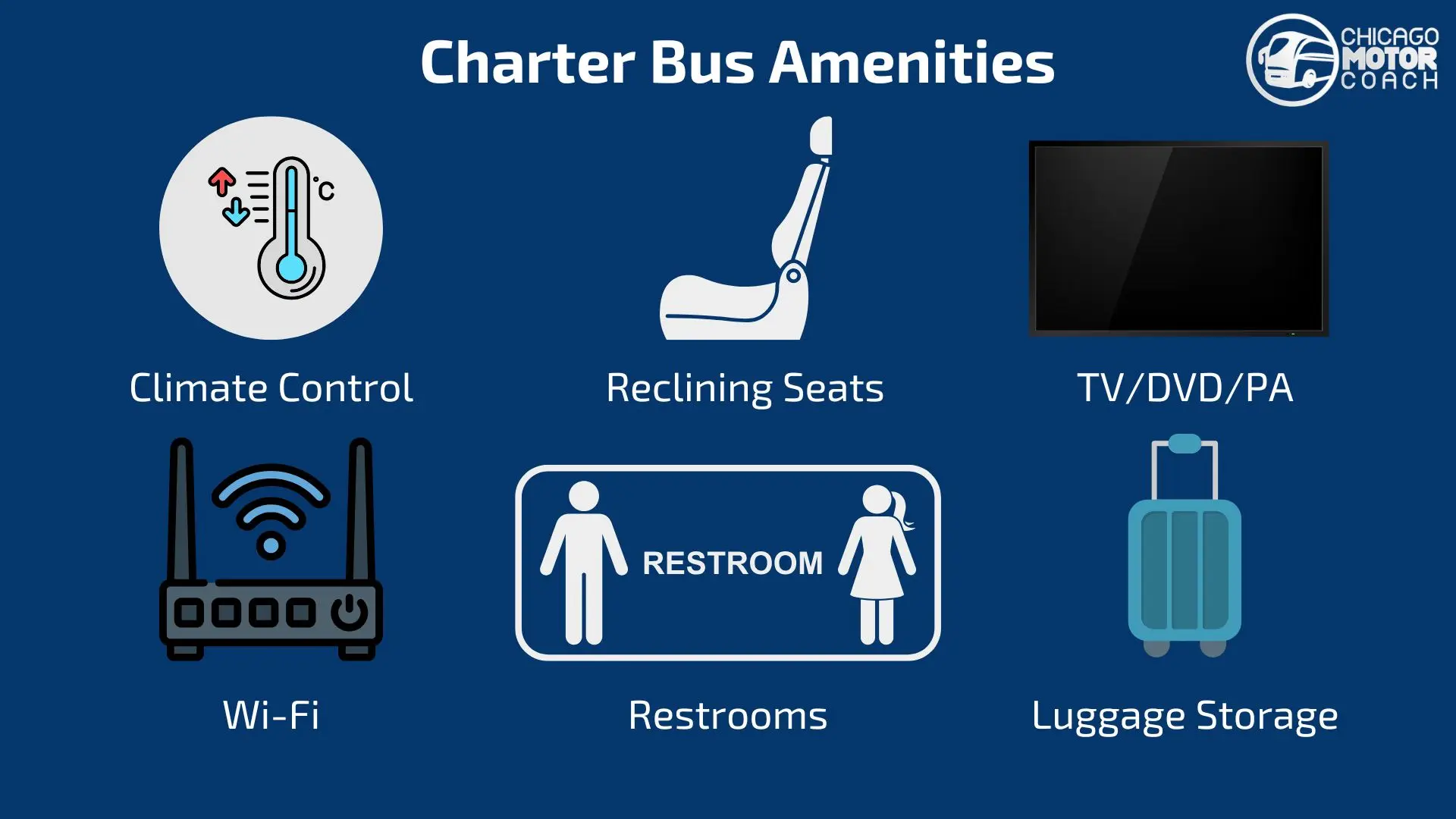
Modern charter buses are worlds apart from the basic buses of decades past. Today’s fleet comes loaded with features designed to make your trip comfortable, productive, and entertaining. Here’s what you can typically expect:

  • Climate control is standard across most charter buses, with many offering individual controls above each seat so everyone can set their preferred temperature.
  • Reclining seats with ample legroom let passengers stretch out and relax — no cramped airline-style seating here.
  • Entertainment options vary by vehicle but often include flat-screen TVs, DVD players, and PA systems for movies, presentations, or music during the ride.
  • Wi-Fi connectivity and charging ports keep devices powered throughout your trip. Wi-Fi typically requires advanced arrangement for an additional fee, while USB or 110-volt outlets are standard.
  • Onboard restrooms are available on larger coach buses, particularly 56-passenger models. This feature is invaluable for long-distance travel, reducing the need for frequent stops.
  • Luggage storage solutions depend on the bus type. Larger motor coaches have underneath compartments, while some models offer overhead storage or configurable rear space for equipment.
What Is a Charter Bus

Exploring Different Charter Bus Types

Charter buses come in various sizes to match different group needs and budgets:

56-Passenger Motor Coach

This is the full-size workhorse of charter bus fleets. With seating for up to 56 people, these buses are perfect for large corporate groups, school trips, or any event where you need to move a significant number of people at once. They feature underneath luggage compartments, onboard restrooms, and typically offer the full range of amenities, including Wi-Fi and entertainment systems.

50-Passenger Coach

The 50-passenger option offers similar comfort and features with a bit more flexibility. One interesting feature some models offer is the ability to convert the rear section into additional storage space — you’ll give up eight seats but gain substantial room for equipment or extra luggage.

40-Passenger Midsize Bus

When your group size falls somewhere in the middle, a 40-passenger bus hits the sweet spot. You get many of the same amenities as the larger coaches but with slightly easier maneuverability and often at a lower price point.

What Is Meant by Charter Bus?

36-Passenger Mini Bus

Perfect for smaller corporate teams or intimate wedding parties, the 36-passenger mini bus delivers comfort without excess capacity. It’s easier to navigate through urban areas and tighter spaces while still providing professional transportation.

28-Passenger Mini Bus

At the smaller end of the spectrum, a 28-passenger mini bus serves groups that need more than a van but don’t require a full-size coach. These are popular for airport transfers, hotel shuttles, and local event transportation.

14-Passenger Mercedes Sprinter Van

For the smallest groups, a 14-passenger Mercedes Sprinter van offers a premium transportation experience with executive-level comfort. These vans are ideal for corporate airport transfers, small executive teams, or intimate group outings where you want the convenience of group travel without a full-size bus.

How Much Does It Cost to Rent a Charter Bus in Chicago?

Charter bus pricing isn’t one-size-fits-all — several factors influence the final cost. Distance and duration play significant roles; a four-hour local trip costs differently than a multi-day interstate journey. The type and size of bus you select impacts pricing, as does the time of year you’re traveling. Peak seasons and weekends often command higher rates than off-season weekday bookings.

The good news is that when you divide the total cost among your entire group, charter bus rental often proves more economical than coordinating multiple cars, dealing with parking fees, or reimbursing individual mileage.

What’s Included in Your Quote?

When you get your quote, it covers the essentials for your trip, like:

  • Driver services
  • Fuel/gas
  • Climate control (AC/Heat)
  • Reclining seats
  • Storage space

Potential Additional Costs

There are a few extra expenses that are not included in your initial quote and that you may have to cover separately:

  • Tolls
  • Parking fees
  • Driver’s hotel room: This applies if your trip requires the driver to stay overnight.
  • Gratuity/tip: While tipping isn’t mandatory or included in the cost, it’s customary to show appreciation to your professional driver with a gratuity, typically 10% of the total trip cost.

When to Book a Charter Bus Trip?

What Is Meant by Charter Bus?

Charter buses make sense for numerous situations. Corporate events and employee outings become far simpler when everyone travels together. School field trips and athletic events benefit from the safety and supervision a charter bus provides. Wedding celebrations flow more smoothly when guests don’t worry about directions, parking, or having a designated driver.

Religious group events, convention transportation, long-distance tours — basically any time you have a group of people who need to be somewhere together, a charter bus deserves consideration.

Are Charter Bus Rental Services Safe?

Safety is paramount in the charter bus industry. Professional drivers undergo extensive training, background checks, and regular evaluations. They hold commercial driver’s licenses with passenger endorsements and understand the unique responsibilities of transporting groups.

Modern charter buses meet strict federal safety standards and undergo regular inspections and maintenance. At Chicago Motor Coach, our drivers maintain perfect safety records, and our vehicles receive meticulous maintenance attention.

Why Hire a Charter Bus in Chicago?

Beyond the obvious convenience of group coordination, charter buses offer compelling advantages:

  • Cost efficiency: When you compare the total expense of multiple vehicles, parking fees, and fuel against a single charter bus rental divided among passengers, the savings add up quickly.
  • Environmental impact: One bus produces far less emissions than a caravan of individual cars making the same journey.
  • Productivity opportunities: Team members can work, meet, or prepare together during travel time rather than everyone focusing on driving separately.
  • Team building: The shared travel experience strengthens relationships and creates bonding opportunities before you even reach your destination.
  • Stress reduction: No one worries about getting lost, finding parking, or staying awake for a late return drive. Your driver handles all of that.
  • Social connection: Conversations flow naturally when groups travel together, and the journey becomes part of the event itself rather than just a means to an end.
What Is Meant by Charter Bus?

Steps to Booking Your Charter Bus

Ready to book? Here’s how to navigate the process:

  1. Find a reputable charter bus company: Look for established companies with proven track records. Check online reviews and verify their credentials, including proper licensing and insurance.
  2. Determine your travel details: Get clear on your travel details before requesting quotes. Where are you going? When do you depart and return? How many passengers? Specific details lead to accurate quotes.
  3. Ask about safety standards: Ask about driver training and vehicle inspection schedules. A quality company welcomes safety questions and provides clear answers.
  4. Select the right vehicle: Review your options based on group size, amenities, and budget.

FAQ

What is the difference between a school bus and a charter bus?

A school bus is designed for short, local routes. They have simple interiors and minimal amenities.
A charter bus is built for comfort, long distances, and versatility. They feature amenities like reclining seats, climate control, restrooms, and luggage storage, making them suitable for trips involving adults or longer travel.

Can I drink on the bus?

You can often drink alcohol on a charter bus for an adult outing, allowing your group to ride safely. A refundable safety deposit may be required.

Are pets allowed on board?

Pets aren’t allowed on charter buses. Service animals are permitted as required by the ADA. If you are bringing a service animal, please notify us in advance.

Book Your Chicago Charter Bus Today!

Choosing charter bus transportation doesn’t have to be complicated. With the right information and a reliable partner, you can secure the perfect vehicle for your group’s needs without stress or uncertainty.

At Chicago Motor Coach, we’ve spent over 30 years helping groups navigate their transportation challenges. Our diverse fleet, experienced drivers, and commitment to customer service mean you’re working with a team that genuinely cares about making your trip successful.

Get a free quote now, and let’s make your group travel experience exceptional with the right charter bus for your needs.

What Is a Coach Bus? A Look at Its History, Seating, and More.

From Lake Shore Drive to Interstate 80, coach buses, or motor coaches, are a familiar sight on Chicago’s roads. These impressive vehicles do more than just transport people — they’re traveling comfort zones that make group travel a genuine pleasure.

A coach bus takes large groups to any destination they want. In many cases, groups charter long-distance coach bus trips between cities, states, or sometimes even countries.

Plus, when you take a coach bus, you can work with a designated and knowledgeable bus driver who stays with you throughout your trip.

Join our team at Chicago Motor Coach as we dive into everything you need to know about coach buses, from their features to their many uses.

What Is Considered a Motor Coach?

Motor Coach Definition

A coach bus isn’t a typical city bus or school bus. Think of it as the first-class option of ground transportation. Unlike regular buses, these vehicles are designed for comfortable, long-distance travel, featuring amenities that make even lengthy journeys enjoyable.

What Are the Dimensions of a Standard Motor Coach?

A typical coach bus measures approximately 40 feet in length and 8 feet, 4 inches in width. As you can imagine, these dimensions require careful consideration for maneuvering and parking, as coach buses must take wider turns and need more advanced planning.

The History of Coach Buses

What Is Considered a Motor Coach?

The history of coach buses spans centuries, beginning with Blaise Pascal’s early concept of scheduled transportation. While horse-drawn charabancs dominated early travel, the invention of the automobile by Karl Benz in 1885 paved the way for modern coach buses.

Companies like Greyhound Lines emerged, connecting the nation. The Great Depression initially impacted the industry, but post-war growth, fueled by the Interstate Highway Bill, led to a significant increase in bus ridership.

How Many Seats Does a Coach Bus Have?

Today, coach buses typically seat between 50 to 56 passengers, depending on how they are configured. The exact number varies based on factors like wheelchair accessibility needs or extra luggage space requirements. Most importantly, these seats are designed for traveling long distances as they have high backs and supportive cushioning.

50-Passenger Coach Bus

The 50-passenger setup prioritizes extra luggage space, making it perfect for trips where travelers bring more gear. This configuration often converts the rear section into additional storage, trading eight seats for valuable cargo room.

56-Passenger Motor Coach

This maximum-capacity configuration utilizes the full interior space for seating, with luggage stored in the underneath compartments. It’s ideal for day trips or situations where passengers travel lightly.

Plan Your Next Group Outing with Ease

Ready to explore Chicago or embark on a road trip? Our coach bus rentals offer comfort and style for your group. Contact Chicago Motor Coach today for a free quote.

What Are the Features of a Coach Bus?

Don’t underestimate a coach bus! Modern coach buses’ amenities can rival the comfort of air travel. Here’s what makes these vehicles special:

  • Premium seating
  • Air conditioning
  • Bathroom facilities
  • LCD screen, CD/DVD player, TV, PA system, WiFi
  • Overhead bins, under-seat spaces, massive luggage compartments
  • 110V/220V outlets and USB charging ports at every seat
  • Safety features like electronic stability control, anti-lock brakes, GPS tracking, and more

What Is a Coach Bus Perfect For?

What Is Considered a Motor Coach?

Coach buses are remarkably versatile vehicles and there are seemingly endless possibilities of how you can utilize them. Here are some common uses:

Pros and Cons of Coach Bus Travel

A coach bus offers an affordable and convenient way to travel in a group. However, it’s important to consider both the advantages and disadvantages to determine if it’s the right choice for your specific travel needs:

AdvantagesDisadvantages
  • Cost-effective for group travel
  • Environmentally friendly compared to multiple cars
  • Professional drivers handle navigation and parking
  • Comfortable seating and amenities
  • Plenty of storage space
  • Great for socializing and group bonding
  • Fixed schedule and routes
  • Longer travel time compared to flying
  • Weather can affect travel plans
  • May need to plan ahead for parking at destinations

How Much Does It Cost to Rent a Coach Bus?

The cost to rent a coach bus varies depending on several factors, including the size and type of bus (mini-buses being more budget-friendly, while executive coaches with luxurious amenities command higher prices), the distance traveled, the rental duration (with longer rentals potentially offering discounts), and the specific travel dates and times (weekends and peak seasons often being more expensive).

Keep in mind there may be additional costs from driver gratuities, tolls, parking fees, onboard amenities like Wi-Fi or entertainment systems, and special requests such as luggage handling or onboard attendants.

To get the most accurate cost estimate, it’s best to contact multiple charter bus companies, provide detailed trip information, and ask about all-inclusive packages that may bundle some expenses.

Ready to Hit the Road? Book Your Chicago Coach Bus.

Whether you’re planning a corporate outing to Milwaukee or a school trip to Springfield, a coach bus offers comfortable, reliable group transportation. Chicago Motor Coach understands the importance of dependable transportation in all seasons — from sweltering summers to windy winters. We’ve been in business for over three decades and have proudly served more than 50,000 customers. You’re in excellent hands! Book your coach bus now!

Which Chicago Bus Tours Are The Best? Top 16 Places to Visit in 2025

Chicago is one of the most popular tourist destinations in the United States. With its beautiful parks, elegant museums and breathtaking destinations, The Windy City will undoubtedly give you and your friends and family an unforgettable experience.

Which Chicago Bus Tours Are The Best? Top 16 Places to Visit in 2020

If you want to experience the best of The Windy City without all the hassle, then Chicago bus tours are your best option.

What is a Chicago City Tour and why is it the best choice?

A city tour is a guided trip of an area where a guide explains the important sights and historical significance of a certain landmark. This is different from a “hop on hop off” tour, another popular city tour option in Chicago where buses travel along mapped routes and travelers have the option to board at several locations throughout the city.

Hop on hop off tours are great if you want to explore the city at your own schedule. However, if you want a detailed tour focusing on group transportation without worrying about getting off at the next stop, then a city tour via bus rental services will give you everything you need.

Best Places to Visit in Chicago

There are so many things to do in Chicago and because of this, it’s easy to get confused about where to go first and how to get there.

Here are the top hotspots of Chicago to jumpstart your tour:

Millennium Park

The Millennium Park is a public park located in the Loop community area of Chicago, Illinois and is one of the city’s most popular attractions. The park was established in 2004 and is one of the biggest free attractions of the city. Admission to the Millennium Park is free and it is open daily from 6AM to 11PM.

Art Institute of Chicago

The Art Institute of Chicago houses more than 300,000 artworks from a variety of media including painting, sculpture, textiles, photography and more. The Institute is well-known for housing a collection of impressionist and post-Impressionist paintings by artists like Georges Seurat and Claude Monet.

Navy Pier

Navy Pier

The Navy Pier is made up of acres of gardens, attractions, shops, and parks. It is also the home of the Centennial Wheel, a 200-foot Ferris wheel which offers visitors a breathtaking view of Chicago and Lake Michigan. Aside from that, you can also watch a film at the 3D IMAX Theater, watch a play at the Chicago Shakespeare Theater or take a stroll through the Crystal Gardens. You will always have something to do at the Navy Pier!

Lincoln Park Zoo

Lincoln Park is Chicago’s biggest park and is the home of the attractions like the Lincoln Park Conservatory and the Lincoln Park Zoo. The zoo was founded in 1868 and is one of the oldest zoos in North America and one of the few free admission zoos in the country. The Lincoln Park Zoo is the home of over a thousand animals from approximately 200 species.

Chicago History Museum

While you’re in Lincoln Park, make sure to visit the Chicago History Museum as well. There, you can take a journey to the city’s (as well as the country’s) proud history through the exhibitions from the museum’s own collection.

Buckingham Fountain

The Buckingham Fountain is located at the heart of Grand Park and is considered to be one of Chicago’s most notable landmarks. It was built in 1927 as a donation from Kate Sturges Buckingham in memory of her brother, Clarence Buckingham. The fountain operates in mid-April through mid-October from 8 AM to 11 PM with water shows occurring every hour lasting 20 minutes.

360 Chicago

360 Chicago

360 Chicago is an observation deck or platform located 1000 feet above the Magnificent Mile in the John Hancock Building and offers a 360 view of the whole city. If you are an adventurer then you would definitely love the deck’s “Tilt” which dares visitors to lean over the side of the building and look straight down from the glass enclosure.

Wrigley Field

Wrigley Field was built in 1924 and is the second-oldest Major League Baseball Park in the United States. Over the years, it has hosted a number of legendary moments in baseball history. For sports fans, a visit to Wrigley Field is a must.

Shedd Aquarium

The Shedd Aquarium is a public aquarium which opened on May 30, 1930, and is now the home of over 30,000 animals from more than 1,500 species including amphibians, fish, marine mammals, birds, snakes and many more. It is one of the attractions of the Museum Campus Chicago along with the Adler Planetarium and the Field Museum of Natural History.

Field Museum of Natural History

The Field Museum of Natural History is one of the largest natural history museums in the world. Permanent exhibitions include Animal Halls which features animal exhibitions and dioramas such as the Nature Walk which allows visitors a close look at the habitats that animals inhabit; the Evolving Planet which follows the evolution of Earth over 4 billion years and Inside Ancient Egypt which gives us a glimpse into the life of ancient Egyptians.

Adler Planetarium

Are you a fan of astronomy and astrophysics? Then the Adler Planetarium is a great place to check out. It was founded in 1930 by Max Adler and is located at the outermost tip of the Museum Campus. There you can watch shows in the Grainger Sky Theater which uses multiple projectors to screen films on a 70-foot-diameter dome. You can also go experience their exhibits such as their popular “Mission Moon” and the “What is a planet?” exhibitions.

Willis Tower Skydeck

Willis Tower Skydeck

The Willis Tower, or more commonly known as the Sears Tower, is a 1,450-foot skyscraper which offers a breathtaking view of all of Chicago. The Skydeck is open all year round, including the holidays!

Museum of Science and Industry

The Museum of Science and Industry has over 2,000 exhibits displayed in 75 major halls and is considered to be the first in the United States to encourage their visitors to interact with their exhibits. It is open every day except for Thanksgiving and Christmas.

Chicago Riverwalk

The Riverwalk provides a path along the Chicago River and is lined with restaurants and bars. There are also several options for river tours and cruises there.

Garfield Park Conservatory

The Chicago Garfield Park Conservatory is one of the largest botanical conservatories in the country. Presently, it houses over 600 species of plants most of which are indigenous to the region.

Soldier Field

Located in the South Loop, Soldier Field is a landmark of Chicago with a rich history. It’s a must-visit for sports fans and architecture buffs alike. Home to the NFL Chicago Bears and the MLS Chicago Fire, Soldier Field opened in 1924 but underwent a major renovation and modernization in 2002. In addition to NFL and MLS games, the 1994 FIFA world cup, 1999 Women’s World Cup, and even NHL games have been played at the stadium. Soldier Field has also hosted countless events, massive concerts, and even offers summer tours.

Final Thoughts

Those are just some of the many places that you can enjoy the best of The Windy City. You can call Chicago Motor Coach Inc. and we will be happy to provide you eco-friendly buses, knowledgeable tour guides and experienced drivers who will gladly take you to your chosen sights. For further questions, please contact us at 847-380-8480. Let us know how we can help you. Get Free QuotePhone

What Is a Mini Bus? All You Need to Know.

Choosing the right vehicle for group travel in Chicago can feel tricky. Too many passengers for a van, but not enough to fill a full motor coach? That’s where a mini bus comes in. At Chicago Motor Coach, we help groups of all sizes find the right transportation solution, and Chicago mini bus rentals are often the perfect fit. These versatile vehicles are roomy, comfortable, and affordable while ensuring your group stays together.

What Exactly Is a Mini Bus?

Think of a mini bus as the “in-between” option in group transportation. It’s larger than a passenger van but smaller than a full coach, carrying anywhere from 22 to 36 people. Mini buses are built with higher ceilings, a roomy aisle, and a sturdy frame, so they’re easy to board and comfortable to ride in. They’re popular for events when traveling together makes the day smoother — whether it’s a corporate team headed to a convention or a family gathering for a wedding.

Seating Capacity: Who Fits on Board?

Mini buses come in different sizes, so you don’t pay for more space than you need. For example, Chicago Motor Coach offers these two mini bus models:

mini buses

28-Passenger Mini Bus

Our 28-passenger mini buses are a great choice for airport transfers, local outings, or small group events. With seating for up to 30 passengers and a sleek interior design, these vehicles deliver both comfort and convenience. Each bus comes with modern entertainment systems and thoughtful amenities to keep every ride smooth and enjoyable.

Features:

  • 28 seats with rear luggage storage, or 30 without
  • Full leather seating for passenger comfort
  • PA system with corded and cordless microphones
  • Overhead storage compartments for carry-ons
  • LED aisle lighting for added visibility
  • Retractable passenger seat belts
  • Magazine nets at each seat

36-Passenger Mini Buses

Our 36-passenger mini buses are ideal for larger groups who want to travel together in comfort. These vehicles are ideal for tours, airport transfers, and city outings, offering the perfect balance of spacious seating, modern amenities, and reliable safety features. Passengers can relax and enjoy the ride with entertainment systems and storage designed for convenience.

Features:

  • 32 seats with rear luggage storage, or 36 without
  • Full leather seating for a polished interior
  • PA system with corded and cordless microphones
  • Overhead storage compartments for personal items
  • LED aisle lighting throughout the cabin
  • Retractable passenger seat belts
  • Magazine nets for added convenience

This flexibility makes them perfect for groups that are too large to split into cars but don’t need a 50-passenger motor coach.

Get your free quote now!

Choose Minibus Convenience!

Secure a 28- or 36-passenger mini bus that’s the perfect combination of comfort, reliability, and convenience. Ideal for corporate shuttles, weddings, school outings, or weekend events, our mini buses keep your group together and on schedule.

Luggage and Gear Space

Storage is often overlooked until the last minute. Mini buses usually include rear storage compartments big enough for luggage, sports gear, or instruments. Onboard shelves and overhead bins keep bags off the floor, leaving the seating area uncluttered and comfortable. This makes them especially useful for airport transfers, school teams, and business travelers with equipment.

Accessibility Options for Everyone

Travel should be inclusive, and many mini buses are designed with accessibility in mind. Certain vehicles feature wheelchair lifts, ramps, or low-entry steps with grab handles. While not every bus in a fleet offers these modifications, requesting an ADA-compliant mini bus when booking is a simple way to ensure every member of your group can ride comfortably and safely.

Mini Bus vs. Midsize Bus

A mid-size bus (sometimes called a mini coach) usually seats around 40 passengers. It offers more space than a mini bus but doesn’t require the capacity of a full motor coach. Mid-size buses are ideal for outings like regional trips, conventions, or school and church outings where a bit more room is needed without going all the way up to 50+ seats.

Key difference: Mini buses are better for small-to-medium groups and shorter distances, while mid-size buses serve groups that are slightly larger or are traveling longer routes.

Mini Bus vs. Midsize Bus

Mini Bus vs. Full-Size Motor Coach

A motor coach is a full-size charter bus, seating 50–56 passengers. These buses are designed for long-distance comfort, featuring larger undercarriage storage, restrooms on board, and amenities that make them ideal for cross-state tours, sporting events, or extended trips.

Key difference: Mini buses are the right fit for mid-sized groups staying closer to home, while motor coaches are built for large groups traveling long distances with more luggage and higher comfort needs.

What’s the Difference Between a Van and a Mini Bus?

Key differences include:

  • Seating capacity: Vans typically hold up to 14 passengers, while mini buses comfortably carry up to 36.
  • Comfort: Mini buses have higher ceilings, wider aisles, and individual seats that make longer rides more pleasant.
  • Storage: Vans offer limited space for luggage, while mini buses often include overhead bins or rear storage.
  • Accessibility: Mini buses may come with low steps or wheelchair lifts, features that most vans lack.
  • Driver: Mini bus rentals usually include a professional driver, while vans are often self-driven.

Mini Bus Rental Pricing in Chicago

Mini Bus Rental Pricing in Chicago

Rates in Chicago vary based on the vehicle size, trip length, and whether you’re renting hourly or for the day. Here’s what you can generally expect for Chicago Motor Coach’s pricing:

  • 28–30 passenger mini bus: $130 per hour, $1,300 per day, or $4.00 per mile.
  • 32–36 passenger mini bus: $135 per hour, $1,350 per day, or $4.25 per mile.

These rental rates are only general estimates and may not reflect the exact cost of your charter bus service. For the most accurate quote, it’s best to speak directly with our charter bus company representative.

These numbers put mini buses in a very affordable range for group travel — especially compared to coordinating multiple rideshares or renting several smaller vans.

When Does a Mini Bus Make Sense?

Mini buses are highly adaptable, making them a go-to choice for many Chicago travelers. Some of the most common uses include:

  • Corporate shuttles: Moving employees or clients between airports, hotels, and events.
  • Weddings and private parties: Keeping guests on schedule without parking hassles.
  • School and university trips: Safe travel for field trips, performances, or sports.
  • Airport transfers: Stress-free rides to O’Hare or Midway with room for luggage.
  • Religious or community groups: Transportation for retreats, services, and volunteer activities.
  • Special outings: From concerts to Cubs games, arrive together and avoid traffic stress.
  • Sporting events: Travel together to games and avoid the hassle of crowded parking lots.
  • Concert transportation: Get your group to and from Chicago venues safely and on time.
  • Hotel shuttles: Convenient transport for groups staying at hotels, whether heading to conferences or city attractions.

In every case, a mini bus makes the logistics simple, safe, and cost-effective.

Book Your Mini Bus with Chicago Motor Coach Today!

Mini buses combine convenience, affordability, and comfort. They’re the perfect middle ground between vans and full-size motor coaches, suitable for a range of outings. At Chicago Motor Coach, we provide well-maintained vehicles, professional drivers, and 24/7 support to keep your plans running smoothly. No matter your destination, you can count on our team to get you there safely.

Ready to organize group travel? Reserve your mini bus today and give your group a ride that’s as enjoyable as the destination.

Bus vs. Coach Bus: Which One Fits Your Travel Needs?

Choosing between a coach and a bus can feel confusing when both seem to offer similar transportation. The truth is, these vehicles serve different purposes with distinct features that make each one the better choice for specific travel scenarios.

Whether you’re planning corporate events, school field trips, or long-distance travel, understanding these differences helps you select the right option. Chicago coach buses from Chicago Motor Coach provide the comfort and reliability your group needs for any journey.

What is the difference between a bus and a coach? Quick comparison

The Basics of Bus and Coach Travel

Before exploring specific differences, it’s helpful to establish what each vehicle actually is. While both transport passengers, their design, purpose, and capabilities vary significantly. Here’s what defines each type of transportation.

What Is a Bus?

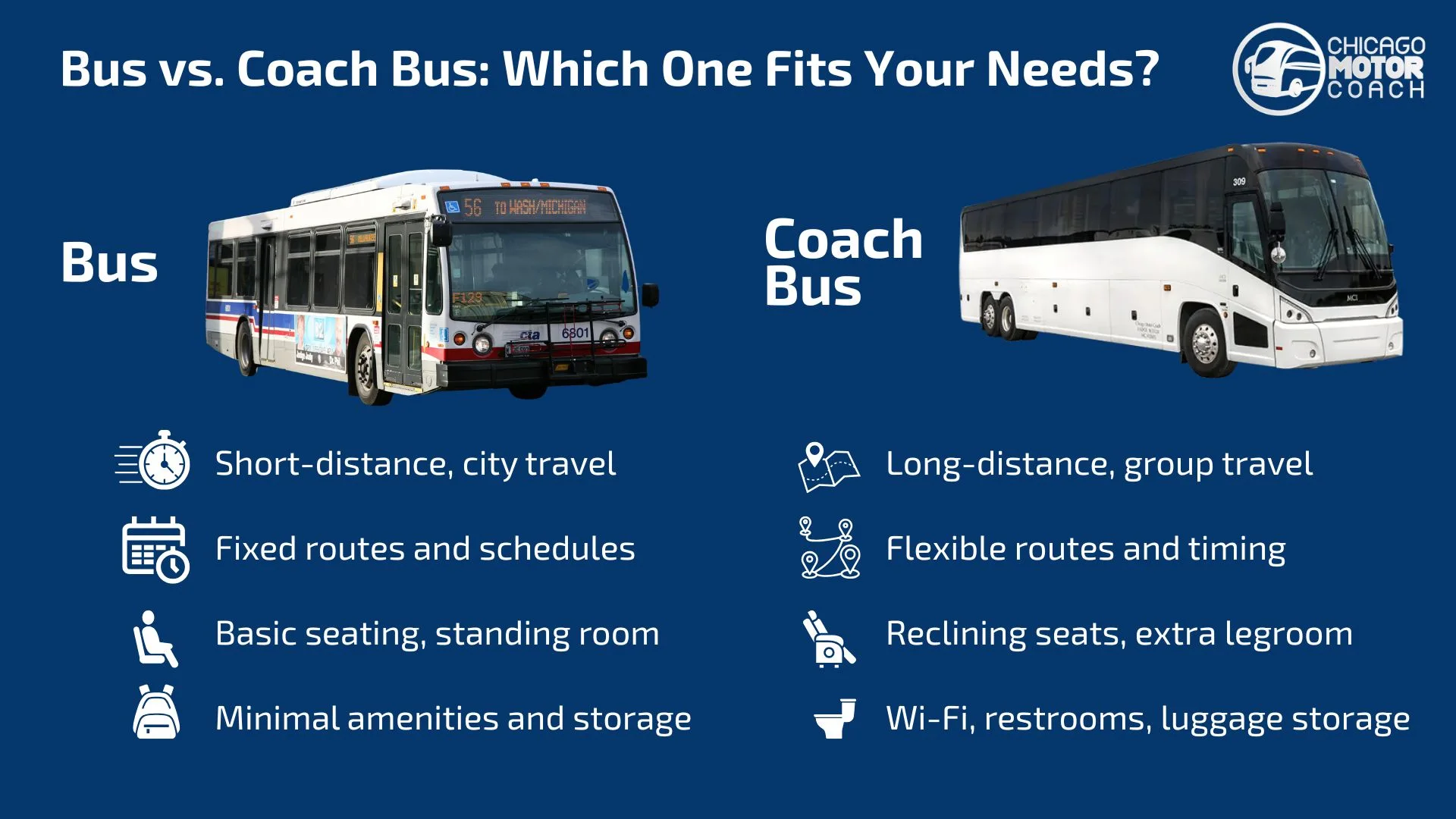
A bus is designed primarily for public transportation along fixed routes with frequent stops. Transit buses operate within cities, picking up standing passengers at designated locations throughout the day. These vehicles feature bench-style seating, wheelchair lifts, and standing areas to maximize capacity for short-distance travel.

What Is a Coach?

A coach bus focuses on comfort for longer journeys between cities or states. Modern coach buses include reclining seats, onboard restrooms, luggage storage beneath a raised floor, and climate control. Charter buses operate on flexible schedules for private group transportation rather than predetermined routes.

Key Differences Between Coaches and Buses

The bus vs. coach debate centers on several core distinctions. Understanding these differences helps you make informed transportation decisions for your group. Below is a quick comparison, followed by detailed explanations of each factor.

FeatureBusCoach
Primary UsePublic transit, short tripsPrivate charter, long-distance
SeatingBench style, standing areasReclining, individual seats
RoutesFixed, predeterminedFlexible, customizable
AmenitiesBasic (AC, wheelchair lift)Premium (Wi-Fi, restrooms, entertainment)
StopsFrequent (every few blocks)Limited (direct point-to-point)
CostLow per-person fareGroup rate, cost-effective for large groups
StorageMinimal overhead spaceUndercarriage compartments, overhead bins
Ideal DistanceUnder 20 miles50+ miles

Purpose and Usage

Transit buses serve everyday commuters traveling short trips within metropolitan areas. The first bus line opened to provide cost-effective transportation for people needing frequent, reliable access to work and essential services. These vehicles run on regular schedules with high-frequency service.

Coach buses excel at long-distance trips for large groups attending special occasions, corporate events, or religious gatherings. Unlike standard buses, luxury coach buses don’t follow fixed routes. Instead, they travel point-to-point based on your group’s specific itinerary, making fewer stops for a more comfortable journey.

Seating and Comfort

Standard buses prioritize passenger capacity over individual comfort. Seats are firm, upright, and spaced closely together. Many transit buses include standing areas since not all buses offer enough seats during peak hours. This design works well for passengers traveling only a few miles.

Luxury coaches transform travel into a pleasant experience with plush, reclining seats that rival airline business class. Each passenger gets their own comfortable seat with extra legroom. The raised floor creates space underneath for luggage storage, eliminating overhead crowding. You’ll find options for various group sizes depending on your needs.

Amenities and Features

Transit buses keep amenities basic because riders typically spend less than an hour onboard. You’ll find wheelchair lifts, air conditioning, and occasionally USB charging ports. The body style emphasizes durability and easy passenger flow rather than premium features.

Motor coaches include amenities that make hours of travel enjoyable:

  • Power outlets and Wi-Fi for staying connected
  • Entertainment systems with audio systems and video screens
  • Onboard restrooms for convenience
  • Climate control for year-round comfort
  • Overhead storage plus undercarriage compartments

These other amenities especially matter when you’re spending several hours on the road for long-distance trips or multi-day adventures.

Travel in Premium Comfort

Our modern coach buses deliver the space and amenities your group needs

Routes and Flexibility

City or transit buses operate along predetermined routes that rarely change. Passengers board at specific stops according to published schedules. This system works efficiently for urban areas where many people travel similar paths daily. However, you can’t request route changes or custom pickup locations.

Charter buses provide complete flexibility for your travel plans. You choose pickup locations, departure times, and destinations. Planning a field trip? Your driver collects students directly from school. Organizing convention transportation? We’ll shuttle attendees between hotels and venues on your schedule.

Cost Structure

Public transportation charges low, fixed fares per passenger per trip. This cost-effective transportation helps individuals travel affordably around cities. However, total costs add up quickly when moving large groups, especially if multiple transfers are needed.

Coach rentals charge based on factors like duration, distance, and vehicle size. While the upfront cost appears higher than individual bus tickets, splitting the rate among passengers often proves more economical. You also gain the benefits of traveling together as a cohesive group.

Cost Structure
 

Safety and Regulations

Both vehicles follow strict Department of Transportation standards, but coaches often exceed minimum requirements. Newer models include advanced safety features like:

  • Electronic stability control
  • Anti-lock braking systems
  • Seat belts for every passenger
  • GPS tracking and monitoring

Professional charter bus drivers undergo specialized training beyond what’s required for transit operators. They’re experienced in long hauls, highway driving, and managing group travel logistics. This expertise matters most during overnight trips when passenger safety depends on driver alertness and skill.

Travel Distance

Transit buses handle short trips efficiently, typically traveling routes under 20 miles. These two vehicles — standard buses and school buses — focus on moving people short distances repeatedly throughout the day. Standing passengers can board easily during quick stops.

Coaches excel on longer routes spanning hundreds of miles. The comfortable seats, onboard restrooms, and entertainment systems make extended travel bearable. Groups often choose coaches for trips to Wisconsin, neighboring states, or cross-country adventures. Understanding what to expect on long bus trips helps passengers prepare appropriately.

Travel Distance
 

Passenger Experience

The difference between a bus and a coach becomes most obvious in overall passenger comfort. Transit buses get you from point A to point B efficiently, but the experience focuses purely on transportation. You’ll stand during crowded periods, hold onto handles during acceleration, and exit quickly at your stop.

Coaches prioritize passenger comfort throughout the journey. Entertainment systems keep travelers engaged during multi-hour trips. Climate control maintains comfortable temperatures regardless of weather. The spacious interior allows passengers to move around, stretch, or use onboard restrooms without waiting for scheduled stops. For groups with children or elderly passengers, this comfort makes all the difference.

Choosing the Right Vehicle for Your Needs

Your transportation choice depends on several factors related to your specific situation. Consider these scenarios when deciding between a bus or coach for your next trip.

Choose a transit bus when:

  • You’re traveling alone or with just one or two people
  • Your destination is within city limits along existing routes
  • You need affordable, per-person transportation
  • You don’t have luggage or special equipment
  • Flexible schedules aren’t required

Choose a coach bus when:

  • You’re traveling with a group of 10 or more people
  • Your journey exceeds 50 miles or crosses state lines
  • You require flexible pickup times and custom routes
  • Passenger comfort matters for your event’s success
  • You need secure luggage storage for extended trips
  • Your itinerary includes multiple destinations or stops

Most groups planning school field trips, corporate outings, or special occasions find coaches deliver better value through improved comfort, flexibility, and group cohesion. The difference between coaches and buses justifies the investment when you consider the overall experience and convenience.

Make Every Journey Comfortable

The coach vs. bus decision comes down to purpose, comfort, and flexibility. While buses serve short-distance travel along fixed routes, luxury coaches provide private transportation with premium amenities for longer journeys. Modern coach buses transform travel from a necessity into an enjoyable part of your event.

Chicago Motor Coach has served the Chicagoland area for over 35 years, providing reliable transportation services for more than 50,000 satisfied customers. Our diverse fleet accommodates groups of any size, all maintained to the highest standards. Chicago charter bus rentals from our team ensure your group travels safely and comfortably, whether you’re heading downtown or across state lines. Contact us today to discuss your next trip.

Winter WonderFest 2025 at Navy Pier, Chicago

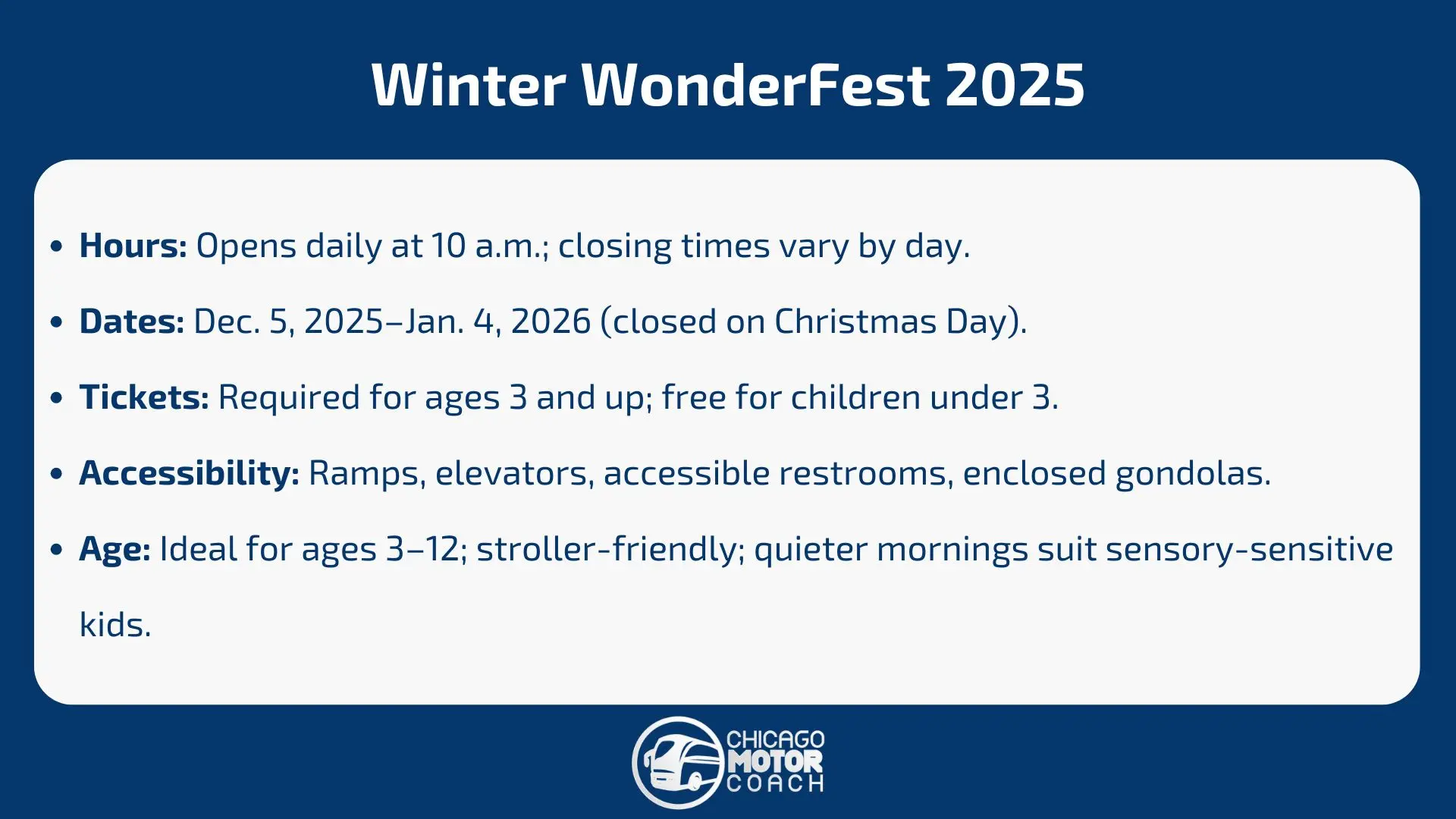
Navy Pier Winter WonderFest (WinterFest) is one of Chicago’s top holiday attractions, offering family fun with food, live music, and thrilling rides. Now a beloved city tradition, each year it draws visitors from across the country and beyond. Since its 1995 reopening, Navy Pier has welcomed over 180 million guests. Want to see it for yourself? Mark your calendars, as this year’s WinterFest runs from Dec. 5, 2025, to Jan. 4, 2026.

A favorite for all ages, this event blends indoor and outdoor entertainment, festive treats, and joyful holiday spirit in one unforgettable experience.

The most convenient and comfortable way to reach Navy Pier with a group is Chicago Motor Coach’s charter bus rental. Skip the parking hassle, keep everyone together, and enjoy a smooth, festive ride to and from Winter WonderFest with a private charter bus tailored to your group’s needs.

Attractions to Visit at Winter WonderFest

Attractions to Visit at Winter WonderFest

Hosted at Navy Pier in Chicago, Winter WonderFest transforms more than 170,000 square feet into a lively indoor winter playground. Locals and visitors alike come to enjoy festive rides, holiday shopping, cultural exhibits, and daily fireworks. Between attractions, warm up with a cup of hot chocolate and sample seasonal treats as you take in the sights and sounds of the season.

Kids will have a blast exploring favorites like the Cliff Hanger, Polar Ice Peaks climbing walls, Kringle Carousel, WonderWhirl tilt-a-whirl, and the indoor Wintertube hill for snow tubing fun. After skating across the ice, don’t miss your chance to soar nearly 200 feet above the lakefront on the Centennial Ferris Wheel — included with every Winter WonderFest ticket. Its enclosed gondolas offer stunning skyline views while keeping you warm and cozy. This is a view you won’t forget!

Attractions to Visit at Winter WonderFest

Guests under 46 inches can enjoy up to 10 rides, while taller visitors can access 11. Children aged three and older will need their own ticket, and some rides may require adult supervision. Although Santa won’t be inside Winter WonderFest this year, families can still find him spreading cheer in the Family Pavilion. Pier Passport Members also receive special discounts, making it even easier and more accessible to join the holiday fun at Navy Pier.

Some of the most popular attractions you shouldn’t miss are:

  • Chicago Blackhawks Ice Skating Rink: Are you into ice-skating? Good news! With an Activity Ticket, you can do as many pirouettes on ice as your heart desires. Just make sure to leave personal items in the locker.
  • Arctic Express Train Ride: Getting tired of walking through all 170,000 feet of Winter WonderFest? Hop on and enjoy the view from this trackless train that runs a 300-foot loop around the holiday village. As a bonus, you’ll get a souvenir photo of you boarding the train.
  • Polar Extreme Course: Let your kids try climbing the cliff hanger with various obstacles obstructing their way.
  • Candy Cane Lighthouse: This attraction is not for the faint-hearted! Let your kids test their courage as Candy Cane takes them up into the air and back to the ground at high speed!
  • Hot Cocoa Cup: Who would’ve thought that riding on the oversized cup could be this entertaining? Make sure not to take your actual cocoa cup with you.
  • Navy Pier Winter Wonder Market: Let your belly feel the Christmas spirit! Visit WinterFest Wonder Market for food specials and delicious drinks. Moreover, you can buy gifts, Chicago-centric souvenirs, and even meet Santa Claus!

Get your free quote now!

Book Your Chicago Charter Bus Rental Today

Plan your group’s stress-free ride to Navy Pier’s Winter WonderFest with Chicago Motor Coach. Contact us today to reserve your bus and experience a smooth, festive, and safe journey from start to finish.

Winter WonderFest 2025–2026 Hours

Get ready for Chicago’s most magical winter tradition! Check this year’s schedule below to plan your visit and make the most of the holiday excitement:

TimeDates
10AM–10PMDec. 5, 6, 12, 13, 19, 20, 22, 23, 26, 27, 29, 30, Jan. 1, 3
10AM–8PMDec. 7, 11, 14, 18, 21, 28, Jan. 2, 4
10AM–5PMDec. 8–10, 15–17, 24, 31
ClosedDec. 25

How to Get to Winter WonderFest

Skip the parking headaches and winter traffic by traveling to Navy Pier’s Winter WonderFest with a private charter bus rental by Chicago Motor Coach. Whether you’re organizing a school trip, company outing, or family holiday adventure, a charter bus keeps everyone together, comfortable, and on schedule. With spacious seating, climate control, and professional drivers who know the city’s routes, you can sit back, relax, and focus on the fun that Navy Pier has to offer.

Our Fleet Options

No matter your group size, our fleet offers a safe, reliable, and stress-free way to enjoy the magic of Winter WonderFest from start to finish.

Arrive in Comfort and Style This Holiday Season with Chicago Motor Coach

Make your Winter WonderFest trip as memorable as the destination itself. With our Chicago charter bus rental services, you can count on safe, reliable, and comfortable transportation for groups of any size. Contact us now to get a quote!‍‍‍

Bus Rental vs. Coach Rental: Which is Right for Your Chicago Adventure?

  1. Introduction: Clearing the Confusion for Your Chicago Trip

  2. Defining the Terms: What is a “Bus Rental” vs. a “Coach Rental”?

  3. The Chicago Bus Rental: Best For Budget & Flexibility

  4. The Chicago Coach Rental: Best For Comfort & Premium Service

  5. Side-by-Side Comparison: A Quick-Reference Chart

  6. Matching Your Trip to the Right Vehicle: 5 Common Scenarios

    • The Corporate Retreat or Client Tour

    • The School Field Trip or Youth Sports Team

    • The Wedding Party & Guest Transportation

    • The Multi-Day Illinois Sightseeing Tour

    • The Night Out or Special Celebration

  7. Cost Analysis: Understanding the Price Difference

  8. Key Questions to Ask Yourself Before Deciding

  9. Conclusion: Making the Confident Choice for Your Group

1. Introduction: Clearing the Confusion for Your Chicago Trip

Planning a trip to Chicago—whether for a corporate event, school outing, wedding, or group tour—often starts with one important transportation question: Should you choose a bus rental or a coach rental? While these terms are sometimes used interchangeably, they actually refer to different types of group transportation, each designed for specific travel needs.

Chicago is a bustling city with diverse attractions, from downtown landmarks and sports venues to suburban event spaces and long-distance travel routes. Choosing the right rental option can impact your comfort, budget, travel efficiency, and overall experience. That’s why understanding the key differences between bus rental and coach rental in Chicago is essential before making a reservation.

In this guide, we’ll break down the confusion by clearly explaining how bus rentals and coach rentals differ, when to use each option, and how to decide which one best fits your Chicago adventure. Whether you’re organizing short local trips or planning long-distance group travel, this comparison will help you make a smart, informed, and stress-free choice.

2. Defining the Terms: What Is a “Bus Rental” vs. a “Coach Rental”?

When searching for group transportation in Chicago, many people assume that bus rental and coach rental mean the same thing. While both options are designed to transport groups efficiently, the terminology actually reflects differences in vehicle type, amenities, and travel purpose. Understanding these distinctions helps ensure you book the right vehicle for your specific trip.

What Is a Bus Rental?

A bus rental typically refers to vehicles designed for short-distance or local transportation. These buses focus on practicality, affordability, and frequent stops rather than luxury or long-haul comfort.

Common characteristics of bus rentals include:

  • Ideal for city travel, local events, and short trips

  • Basic seating with limited onboard amenities

  • Frequent entry and exit for passengers

  • Cost-effective for large groups on tight schedules

In Chicago, bus rentals are often used for school field trips, employee shuttles, church outings, sports team transportation, and local sightseeing tours. These vehicles are well-suited for navigating city streets, handling stop-and-go traffic, and accommodating high passenger volume efficiently.

What Is a Coach Rental?

A coach rental—often called a motor coach—is designed for long-distance travel and premium comfort. Coaches are built with passenger experience in mind, offering enhanced amenities that make extended trips more enjoyable.

Typical features of a coach rental include:

  • Comfortable, reclining seats with extra legroom

  • Climate control for all-season travel

  • Luggage compartments for overnight or extended trips

  • Optional amenities such as Wi-Fi, restrooms, power outlets, and entertainment systems

Coach rentals in Chicago are commonly used for corporate travel, airport transfers, wedding transportation, multi-day tours, and interstate trips. They’re ideal when comfort, professionalism, and reliability are top priorities.

Why the Difference Matters When Booking in Chicago

Choosing between a bus rental and a coach rental isn’t just about terminology—it affects pricing, passenger comfort, travel duration, and overall trip satisfaction. A short local shuttle doesn’t require the same features as a long-distance group journey, and overbooking or underbooking can impact both budget and experience.

By understanding how these two rental options differ, you’ll be better equipped to select the right vehicle for your Chicago travel needs, ensuring a smooth and enjoyable trip from start to finish.

3. The Chicago Bus Rental: Best for Budget & Flexibility

A Chicago bus rental is often the best choice for groups that prioritize affordability, flexibility, and efficient local transportation. These vehicles are designed to handle short-distance travel, frequent stops, and high passenger volume—making them ideal for navigating Chicago’s busy streets and event-heavy schedules.

Why Bus Rentals Are Cost-Effective in Chicago

One of the biggest advantages of a bus rental is its budget-friendly pricing. Since these vehicles offer fewer luxury amenities and are typically used for shorter trips, rental costs are generally lower than coach rentals. This makes them a popular option for organizations and groups looking to maximize value without sacrificing reliability.

Bus rentals help reduce expenses by:

  • Eliminating the need for multiple vehicles

  • Lowering per-passenger transportation costs

  • Offering flexible hourly or daily rental options

  • Reducing fuel and parking logistics in dense Chicago areas

For schools, nonprofits, and large groups, this cost efficiency can make a significant difference.

Flexible Transportation for Local Trips & Events

Chicago bus rentals are built for versatility. They work well for itineraries that involve multiple stops, tight timelines, or changing routes. Whether you’re coordinating pick-ups across neighborhoods or transporting guests between venues, a bus rental provides the flexibility needed to adapt on the fly.

Common local uses include:

  • School field trips and educational tours

  • Employee shuttle services

  • Sports teams and fan transportation

  • Church groups and community events

  • Convention and trade show shuttles

These buses are especially effective for short-distance routes within Chicago and surrounding suburbs.

Designed for High-Capacity, Short-Distance Travel

Bus rentals are optimized for quick boarding, frequent stops, and efficient movement, which is crucial in a city known for traffic, events, and construction zones. Their practical design allows groups to stay on schedule while minimizing logistical headaches.

If your trip doesn’t require premium amenities like reclining seats or onboard restrooms, a Chicago bus rental offers a dependable, economical solution that gets everyone where they need to go—on time and within budget.

4. The Chicago Coach Rental: Best for Comfort & Premium Service

A Chicago coach rental is the preferred transportation option for groups that value comfort, professionalism, and premium travel experience. Designed specifically for long-distance and high-end group travel, coach rentals offer enhanced amenities that elevate every part of the journey—making them ideal for both business and leisure trips.

Superior Comfort for Long-Distance Travel

Coach rentals are built with passenger comfort as a top priority. Unlike standard buses, coaches feature spacious, reclining seats, increased legroom, and smooth suspension systems that reduce fatigue during extended travel.

Key comfort features often include:

  • Plush, high-back reclining seats

  • Climate-controlled interiors for all seasons

  • Quiet, smooth rides on highways and interstates

  • Onboard restrooms for longer routes

For trips outside the city or full-day itineraries, these features make a noticeable difference in overall travel satisfaction.

Premium Amenities for a Better Travel Experience

Many Chicago coach rentals come equipped with modern onboard amenities that enhance convenience and productivity. These upgrades are especially valuable for corporate groups, wedding parties, and multi-day tours.

Common premium amenities include:

  • Wi-Fi connectivity

  • Power outlets and USB charging ports

  • Overhead and undercarriage luggage storage

  • Entertainment systems for presentations or group viewing

These features allow passengers to stay connected, relaxed, and organized throughout the trip.

Ideal for Corporate, Event & Interstate Travel

Coach rentals are commonly used for corporate transportation, airport transfers, weddings, conferences, and interstate travel. Their polished appearance and professional service also make them well-suited for events where first impressions matter.

A Chicago coach rental is especially beneficial for:

  • Executive and business travel

  • Wedding guest transportation

  • Airport group transfers

  • Multi-day tours and out-of-state trips

When comfort, reliability, and premium service are essential, a coach rental delivers a first-class group transportation experience that aligns with higher expectations.

5. Side-by-Side Comparison: A Quick-Reference Chart

To make your decision easier, here’s a clear, side-by-side comparison of Chicago bus rentals vs. Chicago coach rentals. This quick-reference chart highlights the most important differences in comfort, cost, amenities, and ideal use cases, helping you quickly identify which option fits your group’s needs.

FeatureChicago Bus RentalChicago Coach Rental
Best ForShort-distance trips, local events, frequent stopsLong-distance travel, premium events, extended trips
Comfort LevelBasic, functional seatingHigh comfort with reclining seats and extra legroom
AmenitiesMinimal or noneWi-Fi, restrooms, power outlets, entertainment (varies)
Travel DistanceLocal and short routesLong-distance and interstate travel
Luggage SpaceLimitedLarge undercarriage and overhead storage
FlexibilityExcellent for changing routes and schedulesBest for planned, structured itineraries
Professional AppearancePractical and utilitarianPolished, upscale, and event-ready
Typical Use CasesSchool trips, shuttles, sports teams, conventionsCorporate travel, weddings, tours, airport transfers
PricingMore budget-friendlyHigher cost, reflects premium service
Overall ExperienceEfficient and economicalComfortable and luxury-focused

How to Use This Comparison When Booking in Chicago

If your trip involves short travel times, multiple stops, and cost efficiency, a Chicago bus rental is usually the smarter choice. On the other hand, if your group will be traveling long distances, attending formal events, or spending hours on the road, a Chicago coach rental offers the comfort and amenities that make the journey enjoyable.

This comparison helps ensure you choose transportation that aligns with your itinerary, expectations, and budget—not just the vehicle size.

6. Matching Your Trip to the Right Vehicle: 5 Common Scenarios

Choosing between a Chicago bus rental and a Chicago coach rental becomes much easier when you match the vehicle to your specific travel scenario. Below are five of the most common group transportation situations in Chicago, along with the best rental option for each.


The Corporate Retreat or Client Tour

For corporate events, executive travel, or client-facing tours, professionalism and comfort are essential. A Chicago coach rental is the best fit for these scenarios, offering a polished appearance and premium amenities that support productivity and relaxation.

Why a coach rental works best:

  • Comfortable seating for long meetings or travel days

  • Wi-Fi and power outlets for work on the go

  • A professional image that reflects your brand

Coach rentals are ideal for corporate retreats, investor meetings, off-site conferences, and client transportation throughout Chicago and beyond.


The School Field Trip or Youth Sports Team

When transporting students or athletes, safety, capacity, and affordability are top priorities. A Chicago bus rental is typically the most practical and budget-friendly choice for these groups.

Why a bus rental makes sense:

  • Efficient for short-distance travel and frequent stops

  • Cost-effective for large groups

  • Easy boarding and unloading for equipment or backpacks

Bus rentals are commonly used for school field trips, youth sports tournaments, and educational outings across Chicago and nearby suburbs.


The Wedding Party & Guest Transportation

Weddings require reliable transportation that keeps guests together and on schedule. For this scenario, a Chicago coach rental offers the comfort and upscale experience that matches the occasion.

Why a coach rental is ideal:

  • Comfortable seating for guests in formal attire

  • Coordinated group arrivals between venues

  • A clean, elegant appearance for special events

Coach rentals are perfect for transporting wedding parties, family members, and guests between hotels, ceremony sites, and reception venues.


The Multi-Day Illinois Sightseeing Tour

Extended travel across Illinois—or beyond—demands a vehicle built for comfort and endurance. A Chicago coach rental is the best option for multi-day sightseeing tours.

Why a coach rental excels:

  • Reclining seats and climate control for long drives

  • Onboard restrooms and luggage storage

  • Entertainment and connectivity for extended trips

Coach rentals provide a smooth, enjoyable experience for tour groups, travel agencies, and long-distance excursions.


The Night Out or Special Celebration

For local celebrations like birthdays, bachelor or bachelorette parties, and group nights out, a Chicago bus rental offers flexibility and value.

Why a bus rental works well:

  • Easy entry and exit for multiple stops

  • Keeps the group together and eliminates parking concerns

  • Budget-friendly for short, local trips

Bus rentals are ideal for concerts, sporting events, bar hopping, and special celebrations within Chicago.


Final Takeaway for Scenario-Based Booking

The best vehicle depends on distance, comfort expectations, group size, and event type. By matching your trip to the right rental option, you’ll ensure a smooth, efficient, and enjoyable group transportation experience in Chicago.

7. Cost Analysis: Understanding the Price Difference

When planning group transportation for your Chicago adventure, cost is one of the most important factors. Knowing what drives pricing—and how bus rentals and coach rentals differ in their cost structures—helps you budget accurately and avoid surprises.

Here’s a clear breakdown of the major cost components you should consider when comparing bus rental vs. coach rental in Chicago.


1. Base Rental Rate: Size, Type & Duration

The most significant portion of your cost is the base rental rate, which varies depending on:

  • Vehicle type (bus vs. coach)

  • Passenger capacity

  • Rental duration (hourly, daily, or trip-based pricing)

Bus rentals generally cost less per hour or per mile because they are designed for shorter, local trips and include fewer comfort features. Coach rentals, on the other hand, come with premium amenities—so the base rate is typically higher.

💡 Tip: For short, local events (e.g., sports games or concerts), a bus rental is often the most economical choice. For long-distance travel or multi-day trips, the value of a coach rental becomes more apparent despite the higher upfront cost.


2. Mileage & Fuel Charges

Most Chicago transportation companies calculate rental costs based on total miles traveled in addition to the base rate.

  • Bus rentals are generally more fuel-efficient for stop-and-go city travel.

  • Coach rentals may cost more in fuel for long-distance routes, but they’re designed for highway efficiency.

Some companies include fuel in the price, while others charge per mile, so always clarify this up front to avoid unexpected costs.

👉 Pro tip: Estimate your route and mileage ahead of time to compare quotes accurately.


3. Driver Fees & Tipping

Almost all professional group transportation rentals require a licensed driver. Driver-related costs can include:

  • Hourly wages or flat driver fees

  • Overtime charges for extended trips

  • Holiday or special event surcharges

  • Suggested driver tip (typically 15–20%)

These fees are typically similar for buses and coaches, but longer trips or overnight stays may increase total driver costs.


4. Amenities & Add-Ons

The amenities you choose can significantly affect total cost, especially for coach rentals.

Common add-ons include:

  • Wi-Fi and power outlets

  • Onboard entertainment systems

  • Restroom-equipped vehicles

  • Extra luggage space

  • Special event decorations

While add-ons enhance comfort and convenience, they can increase your overall price—so include them only if they deliver real value for your group’s needs.


5. Peak Season & Scheduling Factors

Demand affects prices. In Chicago, peak seasons—such as summer tourism months, holiday weekends, sporting events, and conference dates—can drive up rates.

Factors that can impact pricing include:

  • Weekend vs. weekday travel

  • Major events (e.g., Lollapalooza, Bulls or Cubs games)

  • School graduation dates

  • Wedding season (late spring–early fall)

Booking early and being flexible with your schedule can help you secure better rates.


At-a-Glance: Cost Expectations

Cost ComponentBus RentalCoach Rental
Base Rental RateLowerHigher
Fuel/MileageModerateModerate–High
Driver FeesSimilarSimilar
AmenitiesBasicPremium/Optional
Peak Demand ImpactModerateModerate–High
Overall ValueBest for budget & local tripsBest for comfort & long-distance trips

Maximizing Value Without Overpaying

To ensure the best cost outcome for your Chicago trip:
✔ Request multiple quotes from reputable providers
✔ Clarify what’s included (mileage, waiting time, amenities)
✔ Align rental type with trip duration and comfort needs
✔ Ask about discounts for nonprofits, schools, or repeat customers

Understanding the price difference between bus and coach rentals empowers you to make a smart, budget-friendly decision—without sacrificing quality or service.

8. Key Questions to Ask Yourself Before Deciding

Before booking a Chicago bus rental or Chicago coach rental, taking a few moments to evaluate your trip details can save you money, improve comfort, and prevent last-minute complications. The questions below are designed to help you match your transportation choice to your real needs, not just the lowest price or biggest vehicle.


1. How Long Will We Be Traveling?

Trip duration is one of the most important deciding factors.

  • For short, local trips within Chicago, a bus rental is usually sufficient and more economical.

  • For long-distance or multi-hour travel, a coach rental provides the comfort needed to keep passengers relaxed and satisfied.

If your group will be seated for more than an hour or two, comfort becomes a priority.


2. What Level of Comfort Do My Passengers Expect?

Passenger expectations vary depending on the type of event.

  • Casual outings, school trips, and sports teams typically don’t require premium seating.

  • Corporate groups, wedding guests, and multi-day travelers often expect reclining seats, climate control, and onboard amenities.

Matching comfort level to expectations helps ensure a positive experience for everyone.


3. How Many Stops Are on the Itinerary?

The number of stops can influence both efficiency and cost.

  • Bus rentals excel at routes with frequent stops, quick boarding, and flexible schedules.

  • Coach rentals perform best with structured itineraries and fewer stops, especially on highways.

Consider whether your trip is stop-heavy or more point-to-point.


4. What’s the Total Group Size & Luggage Needs?

Group size and storage requirements are critical.

  • Bus rentals accommodate large groups but often have limited luggage space.

  • Coach rentals offer generous undercarriage storage, making them ideal for overnight bags, equipment, or event gear.

Underestimating luggage needs is a common—and costly—mistake.


5. What’s My Budget vs. My Value Expectation?

While budget matters, value matters more.

  • Bus rentals offer excellent value for local, budget-conscious trips.

  • Coach rentals cost more but deliver greater comfort, convenience, and professionalism—especially for long journeys.

Ask yourself whether saving money or enhancing the experience is the top priority.


6. Does the Occasion Call for a Professional Appearance?

Some events require more than basic transportation.

  • Corporate functions, weddings, and VIP events benefit from the polished appearance of a coach rental.

  • Informal outings and community events usually don’t require premium presentation.

Your vehicle is often the first impression guests receive.


Final Thought Before Booking

If you answer these questions honestly, you’ll quickly identify whether a Chicago bus rental or Chicago coach rental best fits your trip. The right choice ensures comfort, efficiency, and cost control, making your Chicago adventure smoother from start to finish.
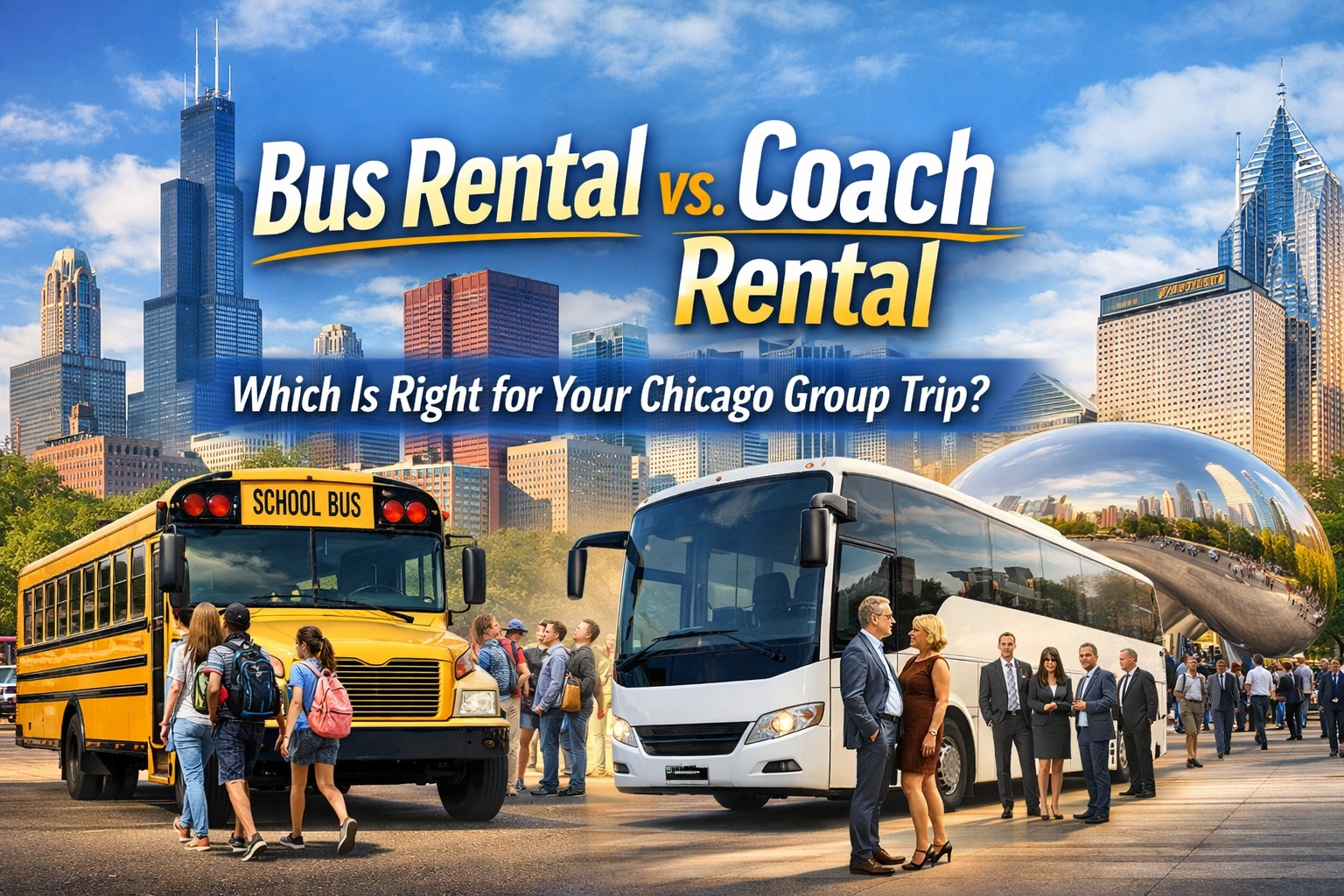
chicago-group-trasnport-options

9. Conclusion: Making the Confident Choice for Your Group

Choosing between a Chicago bus rental and a Chicago coach rental doesn’t have to be complicated. Once you understand the differences in comfort, cost, flexibility, and intended use, the right option becomes clear based on your group’s specific needs.

If your trip involves short distances, frequent stops, and a focus on affordability, a bus rental delivers reliable, budget-friendly transportation that keeps your group moving efficiently through Chicago. It’s an excellent solution for schools, sports teams, local events, and casual group outings.

On the other hand, if your journey includes long-distance travel, formal occasions, or extended time on the road, a coach rental offers the comfort, amenities, and professional appearance that elevate the entire experience. From corporate travel and weddings to multi-day tours, coach rentals provide a premium solution designed for passenger comfort and convenience.

The key to making a confident decision is aligning your itinerary, passenger expectations, and budget with the right vehicle type. By doing so, you avoid overpaying for features you don’t need—or underbooking transportation that falls short of your group’s expectations.

With the right choice, your group transportation becomes more than just a ride—it becomes a smooth, stress-free part of your Chicago adventure.